Fenugreek and Testosterone: What Does the Research Say?
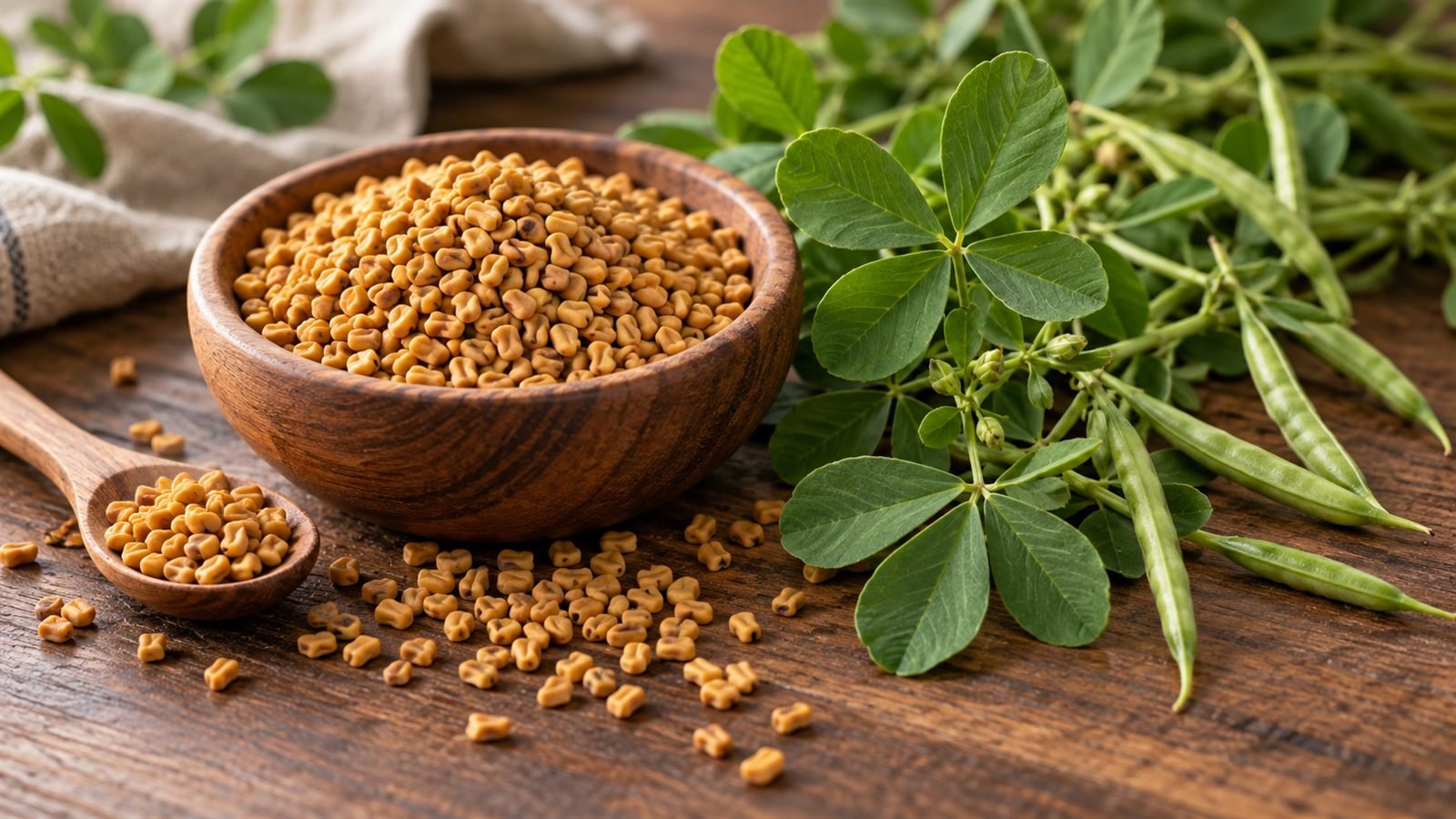
Fenugreek shows up in a lot of "T booster" formulas, often buried in a blend. I wanted to see what the trials actually found before saying anything about it. As with my other ingredient pieces, I'm not a doctor, and this is not medical advice. For the bigger picture, start with my guide on whether testosterone boosters work.
What is fenugreek?
Fenugreek (Trigonella foenum-graecum) is a plant whose seeds are used as a spice and in traditional medicine. Supplements use seed powder or concentrated seed extracts, and many of the trials below tested branded, standardized extracts.
What do the best trials show?
Here are three double-blind, placebo-controlled trials in men, with what each found and what each tested.
| Trial | Who and what | What it found |
|---|---|---|
| Steels et al., 2011 | 60 healthy men aged 25 to 52. 600 mg a day of Testofen, a fenugreek extract and mineral formulation, for 6 weeks. | Higher scores on sexual arousal and orgasm questions. Testosterone and prolactin stayed within the reference range. |
| Rao et al., 2016 | 120 healthy men aged 43 to 70. 600 mg a day of a standardized fenugreek seed extract (Testofen) for 12 weeks. | Lower symptom scores on a questionnaire for possible androgen deficiency, better sexual function, and higher total and free testosterone than placebo. |
| Lee-Ødegård et al., 2024 | 95 men aged 40 to 80. 600, 1,200 or 1,800 mg a day of a fenugreek extract, plus vitamin D, zinc and magnesium, for 12 weeks. | Blood total testosterone was not significantly higher than placebo (9.0% higher, p = 0.122). Saliva testosterone was higher than placebo (37.2%, p = 0.042). Men reported no subjective effects. |
Two things stand out. The results are not consistent from trial to trial. And the 2024 trial, which measured testosterone with more than one method, found different answers in blood and in saliva. That is why I don't take any single trial as the verdict.
There are also fenugreek studies where everyone got the supplement and nobody got placebo, such as an open-label trial of the extract Furosap. Those can't separate the supplement from expectation or from chance, so I don't count them.
What do the reviews conclude?
- 2021, Smith et al. This review covered 32 trials of 13 herbs and concluded that fenugreek seed extracts and ashwagandha had positive effects on testosterone. It also said conclusions were limited by small samples and by variation in doses and extracts (Advances in Nutrition).
- 2020, Mansoori et al. This meta-analysis pooled four randomized trials and found a significant effect of fenugreek extract on total testosterone (Phytotherapy Research).
- 2026, Yang et al. This is the most recent and most cautious one. It pooled randomized placebo-controlled trials and rated the certainty of the evidence for both testosterone outcomes as very low (Frontiers in Nutrition).
In plain words: total testosterone showed a small difference, and the low end of the range sits very close to zero. For free testosterone, the part that is not attached to proteins and is generally considered the active fraction, the range runs well on both sides of zero, so there is no clear benefit. The authors' own conclusion is blunt: the current evidence does not support clinical or commercial testosterone-boosting claims.
Is it the fenugreek, or everything else in the pill?
That is a fair question, and the research doesn't fully answer it.
- Several trials tested more than fenugreek. The 2011 trial used an extract plus minerals, and the 2024 trial added vitamin D, zinc and magnesium.
- The extracts aren't interchangeable. The 2026 review lists trials of Testofen, Furosap, AlphaFen, FEDE, IND9, a fenugreek-mineral combination and a mixed extract, and notes that their standardized components were not the same. A different product from the store isn't guaranteed to match any of them.
- Industry money is common. The 2026 review says industry funding or company involvement was common across the included studies and that this raises concern about selective publication. The 2024 trial was financed by commercial companies, and one author declares being CEO and stockowner of one of them (Vitas Ltd.). The paper says another funder, PurOmega Ltd., had no part in the design, analysis or interpretation. None of this proves bias, but it is worth knowing.
- The men were healthy. The trials above enrolled healthy men, not men diagnosed with low testosterone.
What does this mean for me?
The honest reading: there is a weak signal that some fenugreek extracts can nudge total testosterone up a little, in healthy men, over 6 to 12 weeks. There is no solid evidence that it treats low testosterone, and no evidence about years of use. If your symptoms come from poor sleep, stress or weight, it won't fix those.
If you suspect low testosterone, the right first step is not a supplement. It is a morning blood test, repeated if the result is low. See how to get tested and read the numbers, and my notes on sleep.
Is fenugreek safe?
- The NIH lists diarrhea, nausea and other digestive symptoms as possible side effects.
- Large doses may cause a harmful drop in blood sugar, so ask your doctor if you have diabetes or take blood sugar medication.
- Fenugreek can cause allergic reactions, including serious ones, in some people.
- It is not safe during pregnancy in amounts greater than those found in food. If you take any medicine, the NIH advises talking to your health care provider first (NCCIH).
In the trials, no serious adverse events were reported among the studies that reported them, but the 2026 review says adverse-event reporting was often unclear, the studies were small and short, and long-term safety remains uncertain. In the 2024 trial, two blood markers, ALAT (a liver enzyme) and creatinine (a kidney marker), rose slightly from baseline in most groups, though not significantly more than on placebo. That is a small signal worth knowing about, not proof of harm. For the full picture, read my guide to side effects and who should skip boosters.
What should I check on a fenugreek label?
- The extract and its standardization, not just "fenugreek" or "fenugreek blend".
- The milligrams per serving. Doses in the trials above ranged from 600 to 1,800 mg a day of extract.
- A full supplement facts panel where fenugreek has its own amount, not hidden inside a proprietary blend.
- No vitamin or mineral megadoses, a named manufacturer and third-party testing.
Frequently asked questions
Does fenugreek increase testosterone?
Maybe slightly. A 2026 meta-analysis found a small rise in total testosterone (standardized difference 0.25, 95% CI 0.02 to 0.48) but no clear effect on free testosterone, and rated the certainty of the evidence very low.
Does fenugreek improve libido or sexual function?
Two trials of the Testofen extract reported better scores on sexual function questionnaires. In the 2024 trial, men reported no subjective effects. The evidence is mixed, small and often industry-linked.
How much fenugreek did the studies use?
The trials above used 600 mg a day of a standardized extract for 6 or 12 weeks, and the 2024 trial tested 600, 1,200 and 1,800 mg a day of an extract combined with vitamin D, zinc and magnesium. The doses refer to specific extracts, not to any fenugreek product.
Is fenugreek safe to take every day?
Long-term safety is not known. The NIH lists digestive side effects, a possible drop in blood sugar with large doses and allergic reactions. Talk to your doctor first if you take any medicine.
Should I take fenugreek for low testosterone?
Get a morning blood test first and talk to your doctor. No trial I describe here enrolled men diagnosed with low testosterone, so there is no evidence that fenugreek treats it.
Sources
- Yang P, Niu Z, Guo J, Huang T, Chang D, Huang X. Effects of oral fenugreek-derived preparations on testosterone-related outcomes in adult men: a systematic review and meta-analysis of randomized placebo-controlled trials. Front Nutr. 2026;13:1903508. doi:10.3389/fnut.2026.1903508
- Smith SJ, Lopresti AL, Teo SYM, Fairchild TJ. Examining the effects of herbs on testosterone concentrations in men: a systematic review. Adv Nutr. 2021;12(3):744-765. doi:10.1093/advances/nmaa134
- Mansoori A, Hosseini S, Hosseini S, Zilaee M, Hormoznejad R, Fathi M. Effect of fenugreek extract supplement on testosterone levels in male: a meta-analysis of clinical trials. Phytother Res. 2020:1550-1555. doi:10.1002/ptr.6627
- Steels E, Rao A, Vitetta L. Physiological aspects of male libido enhanced by standardized Trigonella foenum-graecum extract and mineral formulation. Phytother Res. 2011:1294-1300. doi:10.1002/ptr.3360
- Rao A, Steels E, Inder WJ, Abraham S, Vitetta L. Testofen, a specialised Trigonella foenum-graecum seed extract reduces age-related symptoms of androgen decrease, increases testosterone levels and improves sexual function in healthy aging males in a double-blind randomised clinical study. Aging Male. 2016:134-142. doi:10.3109/13685538.2015.1135323
- Lee-Ødegård S, Gundersen TE, Drevon CA. Effect of a plant extract of fenugreek (Trigonella foenum-graecum) on testosterone in blood plasma and saliva in a double blind randomized controlled intervention study. PLoS ONE. 2024:e0310170. doi:10.1371/journal.pone.0310170
- Maheshwari A, Verma N, Swaroop A, et al. Efficacy of Furosap, a novel Trigonella foenum-graecum seed extract, in enhancing testosterone level and improving sperm profile in male volunteers. Int J Med Sci. 2017:58-66. doi:10.7150/ijms.17256 (open-label, single-arm; not counted above)
- National Center for Complementary and Integrative Health. Fenugreek. nccih.nih.gov

Marcus Hale
Writer at The Male Ledger. Not a doctor.
I write about testosterone, energy and vitality after 40, and I link to the studies so you can check my work. Marcus Hale is a pen name; here is why.